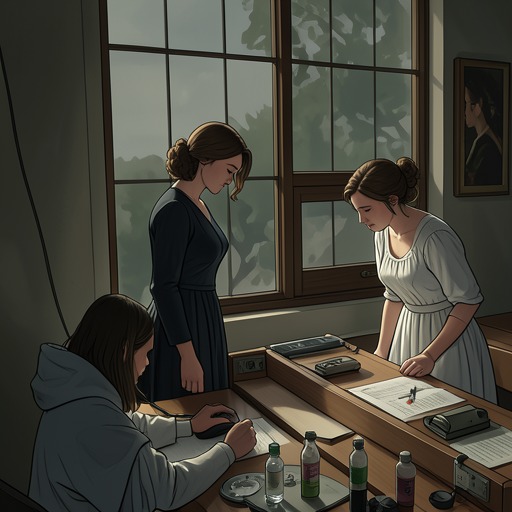
Attack on Miss Avocet’s Time Loop
Miss Peregrine's Home of Peculiar ChildrenThe attack on Miss Avocet’s time loop is a remembered assault that exposes a coordinated campaign against ymbrynes. Told as a warning to Miss Peregrine, it overturns the apparent safety of a protected loop: its children were used as bait, Miss Bunting was abducted, and Miss Avocet escaped only to report that other ymbrynes had also disappeared.
A warning after the attack
Miss Avocet recounts the invasion during a nighttime visit to Miss Peregrine’s home. At first she seems disoriented and sleep-dazed, but recognition gives way to alarm: she tells Miss Peregrine to stay on guard and not be taken by surprise as she was. The warning’s urgency comes from experience rather than speculation; the assault has already breached her own loop and left her unable to account for everyone who was under her protection.
Miss Peregrine asks what attacked them. Miss Avocet identifies the intruders as wights, explaining that two arrived at night in disguise as council members. The imposture exploited the wards’ groggy confusion long enough for the wights to bind and drag them away. Their disguise was not merely a false appearance but the opening move in a carefully timed entry, turning a familiar authority into a means of access.
The invasion and its trap
Miss Bunting and Miss Avocet were awakened by the children’s anguished cries. They found themselves barricaded inside the house; after forcing the doors, they followed the wights’ trail out of the loop, only to encounter a gang of shadow-beasts waiting on the other side. The beasts fell upon them howling. The route out, which might have offered a chance to pursue the kidnappers or escape, instead led directly into a prepared ambush.
Asked about the children, Miss Avocet answers that they were bait. This disclosure revises the apparent purpose of the cries that woke the adults: the children’s danger was used to draw their protectors into the attack. The scene gives the assault a double structure—deception within the house and violence beyond the loop—and shows the attackers exploiting the guardians’ responsibility for those in their care.
Abduction and wider pattern
Miss Avocet escaped, but Miss Bunting did not. Miss Peregrine asks whether Bunting was killed; Avocet clarifies that she was abducted. The distinction makes the danger ongoing: Bunting’s fate is not presented as a confirmed death, but as a disappearance within a campaign whose purpose remains unknown.
Avocet connects the assault to the abductions of Miss Wren and Miss Treecreeper, whose loops were invaded a fortnight earlier, and to the taking of other ymbrynes. The repeated invasions establish that the attack was not an isolated breach but part of a coordinated effort. Avocet cannot say what the abductors intend, and her inability to name their purpose deepens rather than resolves the threat: the pattern is clear, while its endpoint remains hidden.
Consequences for Miss Peregrine’s home
Miss Peregrine immediately recognizes the implication, saying that the attackers will come for them too. Avocet qualifies the danger: Miss Peregrine is better hidden than most, but must be ready if the attackers find her. The warning therefore changes the meaning of concealment. It offers a measure of protection, not security, and turns the account of a distant invasion into a direct threat to Miss Peregrine and the children in her care.
The episode’s structure sharpens that threat by placing the revelation inside a personal appeal. A report of disguises, barricades, a forced exit, and an ambush culminates not in an explanation of the enemy’s purpose but in a warning to prepare. The children’s cries, first heard as an emergency, are revealed as part of the trap; the apparent question of death is answered with abduction; and the attack on one loop becomes evidence that no hidden household can assume it is beyond reach.